Superposition Theorem
The superposition theorem for electrical circuits states that for a linear system the response (voltage or current) in any branch of a bilateral linear circuit having more than one independent source equals the algebraic sum of the responses caused by each independent source acting alone, where all the other independent sources are replaced by their internal impedances.
To ascertain the contribution of each individual source, all of the other sources first must be "turned off" (set to zero) by:
- Replacing all other independent voltage sources with a short circuit (thereby eliminating difference of potential i.e. V=0; internal impedance of ideal voltage source is zero (short circuit)).
- Replacing all other independent current sources with an open circuit (thereby eliminating current i.e. I=0; internal impedance of ideal current source is infinite (open circuit)).
This procedure is followed for each source in turn, then the resultant responses are added to determine the true operation of the circuit. The resultant circuit operation is the superposition of the various voltage and current sources.
Simple Steps to Apply Superposition Principle:
1.
Turn off all
independent sources except one source. Find the output (voltage or current) due
to that active source using nodal or mesh analysis.
2.
Repeat step
1 for each of the other independent sources.
3.
Find the
total contribution by adding algebraically all the contributions due to the
independent sources.
Another point that
should be considered is that superposition only works for voltage and current
but not power. In other words the sum of the powers of each source with the
other sources turned off is not the real consumed power. To calculate power we
should first use superposition to find both current and voltage of each linear
element and then calculate the sum of the multiplied voltages and currents.
Overview and Insights
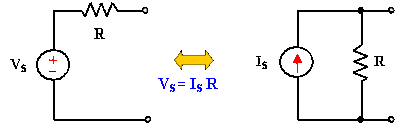
In this week we discussed about the superposition theorem, where one of the sources is removed and the other is solved using voltage division or current division. In using the
Superposition, we replace the voltage source with a short circuit on its place,
and an open circuit when we replace the current source. We turn off other
independent sources except one source. After converting the circuit by
superposition, we can use nodal and mesh analysis or any other techniques to
get the value of the output voltage or current. We add the two results to get
the answer.
Example: Vo =
Va + Vb or Io = Ia + Ib




 \
\